
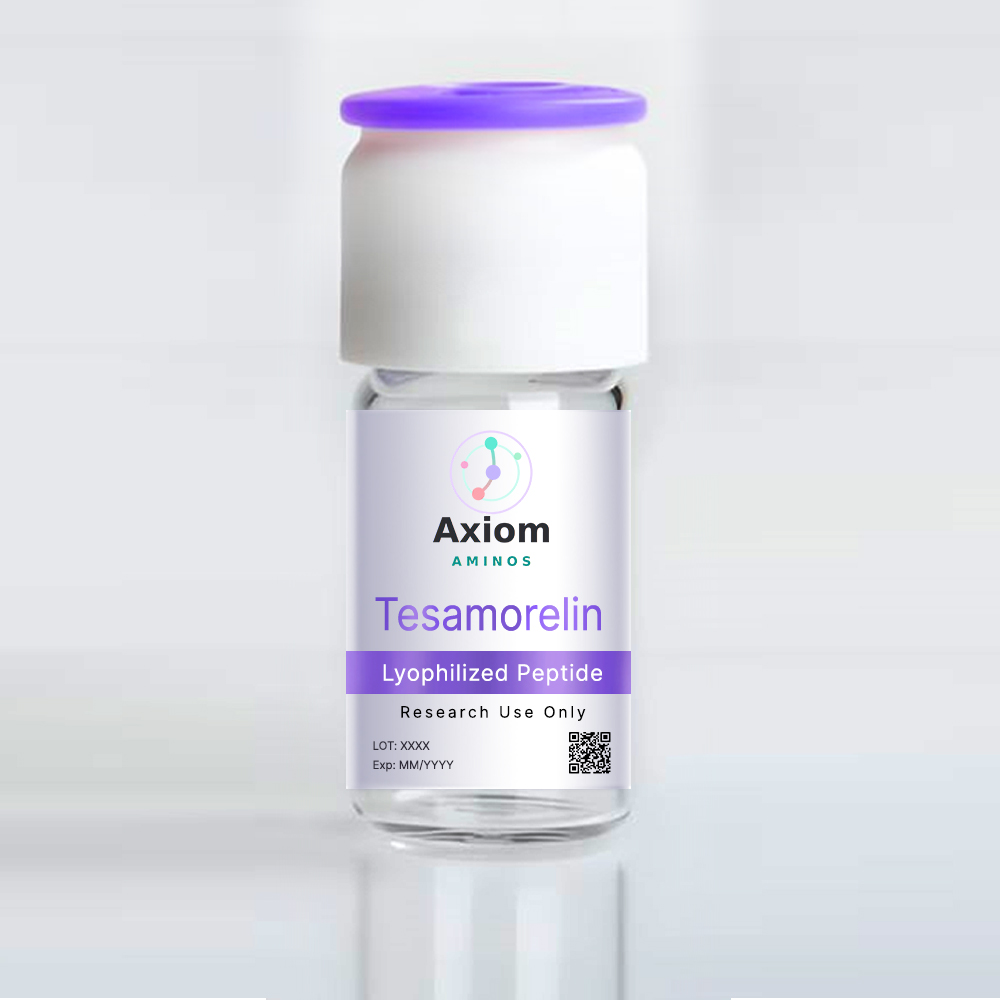
PEPTIDES
$169.00
⚠️ For Research Use Only — This product is not intended for human consumption. By purchasing, you confirm you are a qualified researcher.
Tesamorelin is a synthetic analog of the full 44-amino acid human growth hormone-releasing hormone, modified with a trans-3-hexenoic acid group at the N-terminus. This modification enhances peptide stability while maintaining full GHRH receptor agonist activity. As a research peptide, tesamorelin is used in preclinical studies examining GHRH receptor signaling, lipid metabolism, and hepatic fat accumulation models.
Tesamorelin retains the complete GHRH(1-44) sequence with an N-terminal trans-3-hexenoic acid modification that improves resistance to enzymatic degradation. This structural feature distinguishes tesamorelin from truncated analogs like sermorelin (1-29) and modified analogs like CJC-1295. The peptide acts as a full agonist at the GHRH receptor, activating Gs/adenylyl cyclase/cAMP/PKA signaling in somatotroph cells. Research has demonstrated that tesamorelin-stimulated GH release produces downstream effects on hepatic lipid metabolism and visceral adipose tissue composition. Published studies have examined tesamorelin’s effects on lipid oxidation pathways, IGF-1 production, and body composition parameters in preclinical models (Falutz et al., New England Journal of Medicine, 2007). The full-length GHRH sequence provides researchers with a structurally distinct tool for studying GHRH receptor pharmacology compared to truncated analogs.
Tesamorelin binds the GHRH receptor with high affinity, activating the Gs-coupled cAMP/PKA cascade. The N-terminal hexenoic acid modification protects against aminopeptidase cleavage without altering receptor binding kinetics. Downstream PKA activation drives CREB phosphorylation and GH gene transcription. The resulting GH release stimulates hepatic IGF-1 production and activates lipolytic pathways in adipose tissue through GH receptor and IGF-1 receptor signaling. Research has particularly focused on tesamorelin’s effects on lipid metabolism pathways, including AMPK activation and fatty acid oxidation in hepatic and adipose tissue models.
Tesamorelin contains the full 44-amino acid GHRH sequence with an N-terminal modification, while Sermorelin uses only the first 29 residues. CJC-1295 (No DAC) uses a truncated 30-amino acid sequence with DPP-IV-resistant substitutions. Each analog offers distinct pharmacokinetic and structural properties for different experimental applications.
Related products in the Axiom Research Supply catalog: Sermorelin, CJC-1295 (No DAC), Ipamorelin.
Reconstitute in sterile water. Store reconstituted peptide at 2–8°C and use within 14 days. Lyophilized storage at -20°C. Protect from light and moisture.
Axiom Research Supply provides Tesamorelin at ≥98% (HPLC verified), verified through independent HPLC analysis with third-party testing documentation. Every batch undergoes rigorous quality control including identity confirmation, purity assessment, and endotoxin testing. Our peptides are properly lyophilized and shipped with cold-chain protocols to maintain stability from production to your laboratory. Axiom Research Supply is committed to advancing metabolic peptide science with precision, reproducibility, and dedicated research support. Access our educational resources including the Axiom Research Supply Metabolic Peptide Research eBook for comprehensive scientific background.
| Product Name | Tesamorelin |
| Available Sizes | Multiple dosage options available — see product listing |
| CAS Number | 218949-48-5 |
| Molecular Formula | C221H366N72O67S |
| Molecular Weight | 5135.89 g/mol |
| Purity | ≥98% (HPLC verified) |
| Physical Form | Lyophilized Powder |
| Storage | Store at -20°C, protect from light and moisture |
| Peptide Class | Modified GHRH Analog |
| Key Receptor Targets | GHRH Receptor (GHRH-R) |
| Research Applications | GHRH receptor signaling, lipid metabolism studies, hepatic fat models, GH-IGF-1 axis research |
Reviews
There are no reviews yet.