
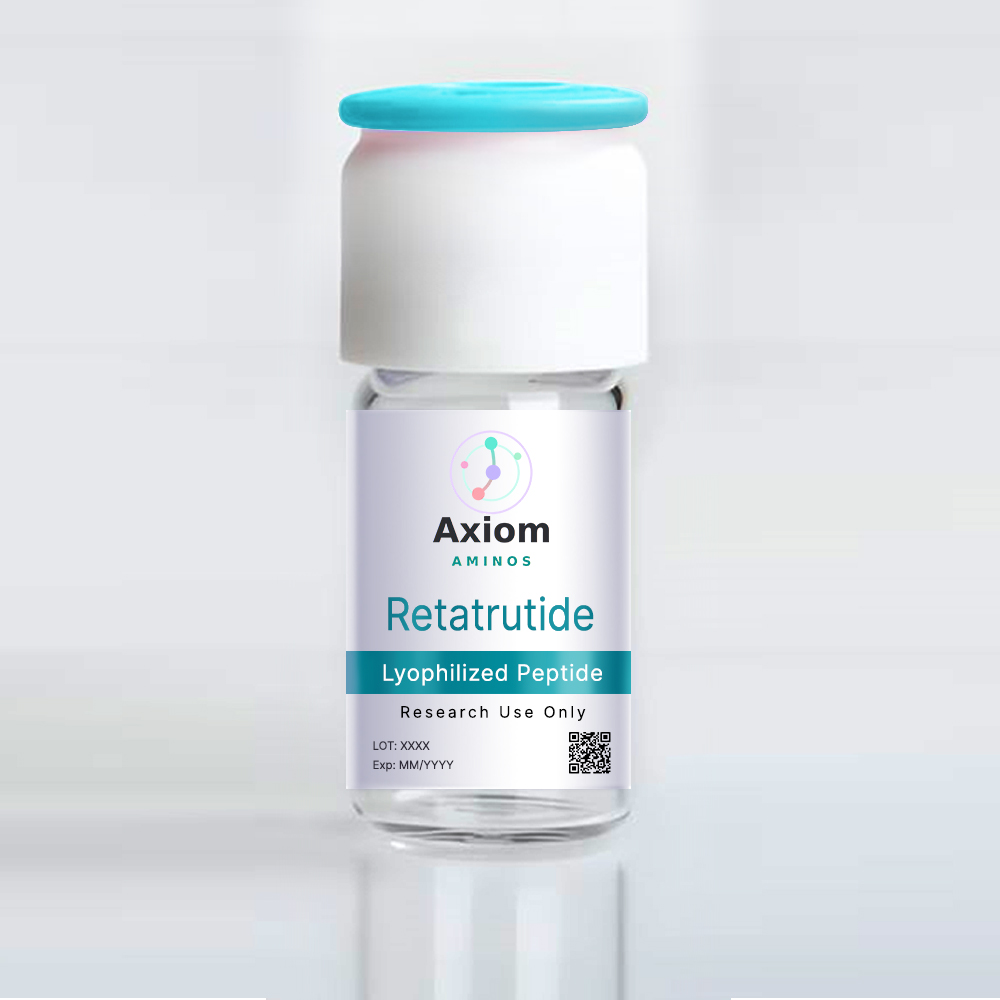
PEPTIDES
$30.00
⚠️ For Research Use Only — This product is not intended for human consumption. By purchasing, you confirm you are a qualified researcher.
Retatrutide (LY3437943) is a synthetic peptide designed to activate three key metabolic receptors: the GIP receptor (GIPR), GLP-1 receptor (GLP-1R), and glucagon receptor (GCGR). As a triple agonist research peptide, retatrutide creates a coordinated, multi-pathway model for studying energy homeostasis, hepatic lipid metabolism, and thermogenesis. It represents the next evolution beyond dual incretin agonists in metabolic peptide research.
Retatrutide was engineered to engage three receptor systems simultaneously, each contributing distinct metabolic effects. Structural studies show that the peptide interacts with each receptor at different affinity levels: high affinity for GLP-1R (EC50 approximately 0.8 nM), moderate affinity for GIPR, and lower affinity for GCGR. This graded receptor activation profile is by design, as glucagon receptor engagement at lower intensity contributes to hepatic fat burning and thermogenesis while the incretin components support insulin release and glucose balance. Preclinical research has demonstrated that retatrutide activates three major signaling pathways: cAMP/PKA (enhancing insulin secretion), PI3K/Akt (improving glucose uptake), and AMPK (increasing energy utilization and fatty acid oxidation). Published studies have shown retatrutide’s effects on metabolic dysfunction-associated steatotic liver disease models (Sanyal et al., Nature Medicine, 2024), highlighting its unique multi-pathway metabolic coordination.
Retatrutide engages all three receptors as a unified signaling platform. At GLP-1R, it stimulates cAMP/PKA-mediated insulin secretion and POMC neuron activation for satiety signaling. At GIPR, it activates PI3K/Akt pathways in adipocytes, enhancing lipid uptake and insulin sensitivity. At GCGR, it promotes hepatic glycogenolysis, fatty acid oxidation, and thermogenesis through cAMP-mediated activation of lipase pathways and mitochondrial uncoupling. The synergistic interaction produces greater metabolic effects than activating any single or dual pathway. The glucagon receptor component specifically enhances energy expenditure, distinguishing retatrutide from dual agonists like tirzepatide.
Retatrutide extends beyond tirzepatide’s dual GIPR/GLP-1R agonism by adding glucagon receptor activation, which contributes thermogenesis and hepatic fat oxidation. Semaglutide activates only GLP-1R. This progression from mono to dual to triple agonism provides researchers with a spectrum of tools for studying incremental pathway addition.
Related products in the Axiom Research Supply catalog: Tirzepatide, Semaglutide, Cagrilintide.
Reconstitute in sterile water. Store reconstituted peptide at 2–8°C. Lyophilized storage at -20°C. Protect from light and moisture.
Axiom Research Supply provides Retatrutide at ≥98% (HPLC verified), verified through independent HPLC analysis with third-party testing documentation. Every batch undergoes rigorous quality control including identity confirmation, purity assessment, and endotoxin testing. Our peptides are properly lyophilized and shipped with cold-chain protocols to maintain stability from production to your laboratory. Axiom Research Supply is committed to advancing metabolic peptide science with precision, reproducibility, and dedicated research support. Access our educational resources including the Axiom Research Supply Metabolic Peptide Research eBook for comprehensive scientific background.
| Product Name | Retatrutide |
| Available Sizes | Multiple dosage options available — see product listing |
| CAS Number | 2381089-83-2 |
| Molecular Formula | C228H349N49O67 |
| Molecular Weight | 4892.53 g/mol |
| Purity | ≥98% (HPLC verified) |
| Physical Form | Lyophilized Powder |
| Storage | Store at -20°C, protect from light and moisture |
| Peptide Class | Triple GIP/GLP-1/Glucagon Receptor Agonist |
| Key Receptor Targets | GIP Receptor (GIPR), GLP-1 Receptor (GLP-1R), Glucagon Receptor (GCGR) |
| Research Applications | Triple receptor metabolic signaling, hepatic lipid oxidation, energy expenditure models, glucagon receptor research, multi-agonist pharmacology |
Reviews
There are no reviews yet.