
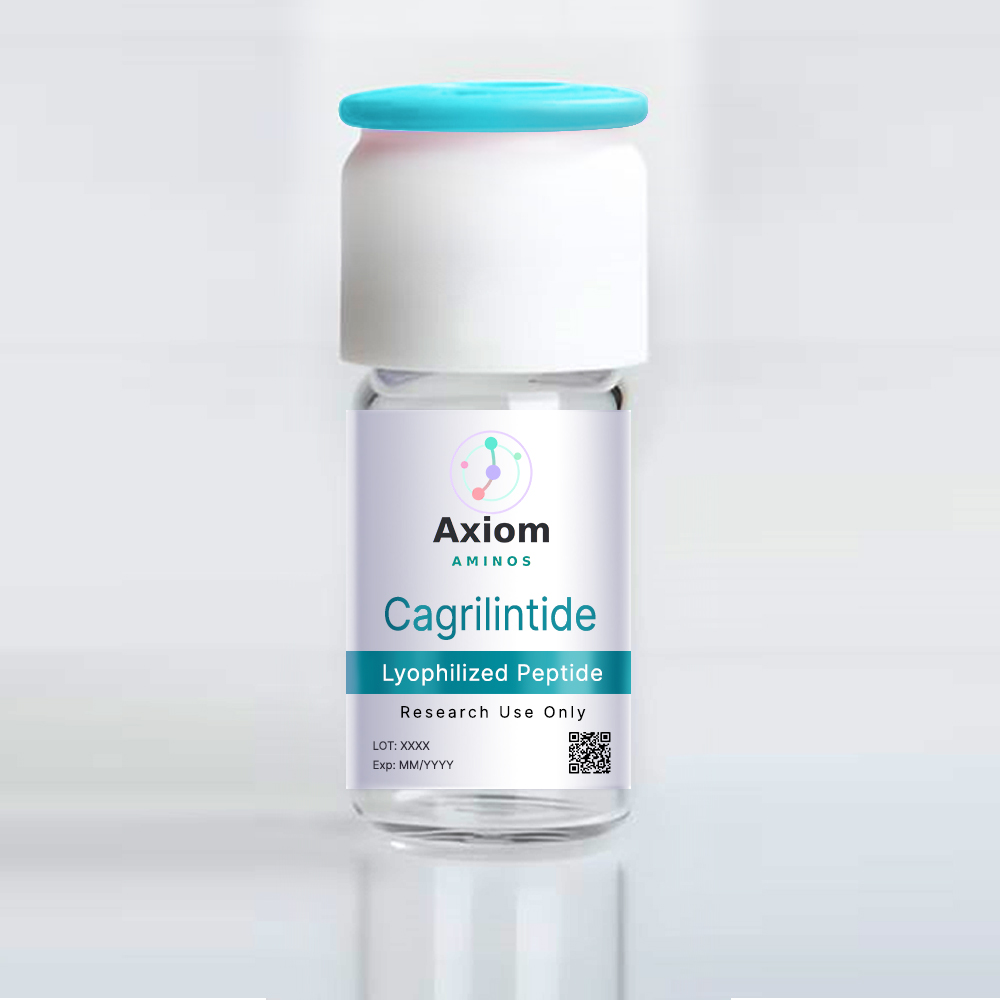
PEPTIDES
$179.00
⚠️ For Research Use Only — This product is not intended for human consumption. By purchasing, you confirm you are a qualified researcher.
Cagrilintide is a long-acting synthetic analog of human amylin, engineered with advanced medicinal chemistry modifications that confer resistance to enzymatic degradation and extend its functional duration. This research peptide activates amylin receptors (AMY1-3) to modulate appetite signaling, gastric motility, and glucagon secretion, providing researchers with a tool for studying amylin-mediated metabolic regulation distinct from incretin pathways.
Cagrilintide was designed through advanced peptide engineering to overcome the limitations of native amylin, which is rapidly degraded by DPP-4 and serum proteases. Structural modifications improve stability and extend functional activity, allowing for sustained receptor engagement in experimental models. The peptide has a balanced affinity for AMY1-3 receptors, which are heterodimeric complexes of the calcitonin receptor (CTR) with receptor activity-modifying proteins (RAMPs 1-3). This broad receptor engagement supports effective appetite modulation while maintaining tolerability compared to earlier amylin compounds. Research has demonstrated that cagrilintide activates amylin-mediated satiety signaling through area postrema neurons and brainstem pathways, operating through mechanisms complementary to but distinct from GLP-1 receptor agonism (D’Ascanio et al., Cardiology in Review, 2024). This positions cagrilintide as a tool for studying multi-hormonal approaches to metabolic regulation.
Cagrilintide binds AMY1-3 receptor complexes, activating Gs-coupled cAMP signaling and calcium-mediated pathways in target neurons. In the area postrema and nucleus of the solitary tract, amylin receptor activation modulates satiety signaling by enhancing noradrenergic and serotonergic neurotransmission. The peptide also inhibits glucagon secretion from pancreatic alpha-cells through direct receptor-mediated effects. Downstream signaling involves CREB phosphorylation, MAPK/ERK pathway activation, and modulation of hypothalamic feeding circuits. The long-acting modifications resist peptidase degradation, enabling extended receptor occupancy.
Unlike semaglutide and tirzepatide, which act through incretin receptors (GLP-1R and GIPR), cagrilintide operates through the amylin receptor system. This complementary mechanism makes cagrilintide valuable for studying multi-hormonal metabolic regulation when combined with incretin agonists.
Related products in the Axiom Research Supply catalog: Semaglutide, Tirzepatide, Retatrutide.
Reconstitute in sterile water. Store reconstituted peptide at 2–8°C. Lyophilized storage at -20°C. Protect from light and moisture. Handle with attention to physicochemical properties to avoid aggregation artifacts.
Axiom Research Supply provides Cagrilintide at ≥98% (HPLC verified), verified through independent HPLC analysis with third-party testing documentation. Every batch undergoes rigorous quality control including identity confirmation, purity assessment, and endotoxin testing. Our peptides are properly lyophilized and shipped with cold-chain protocols to maintain stability from production to your laboratory. Axiom Research Supply is committed to advancing metabolic peptide science with precision, reproducibility, and dedicated research support. Access our educational resources including the Axiom Research Supply Metabolic Peptide Research eBook for comprehensive scientific background.
| Product Name | Cagrilintide |
| Available Sizes | Multiple dosage options available — see product listing |
| CAS Number | 2170592-42-0 |
| Molecular Formula | C165H262N40O55S3 |
| Molecular Weight | 3764.22 g/mol |
| Purity | ≥98% (HPLC verified) |
| Physical Form | Lyophilized Powder |
| Storage | Store at -20°C, protect from light and moisture |
| Peptide Class | Long-Acting Amylin Analog |
| Key Receptor Targets | Amylin Receptors (AMY1-3) |
| Research Applications | Amylin receptor signaling, appetite regulation models, energy homeostasis, beta-cell co-secretion studies, satiety pathway research |
Reviews
There are no reviews yet.