
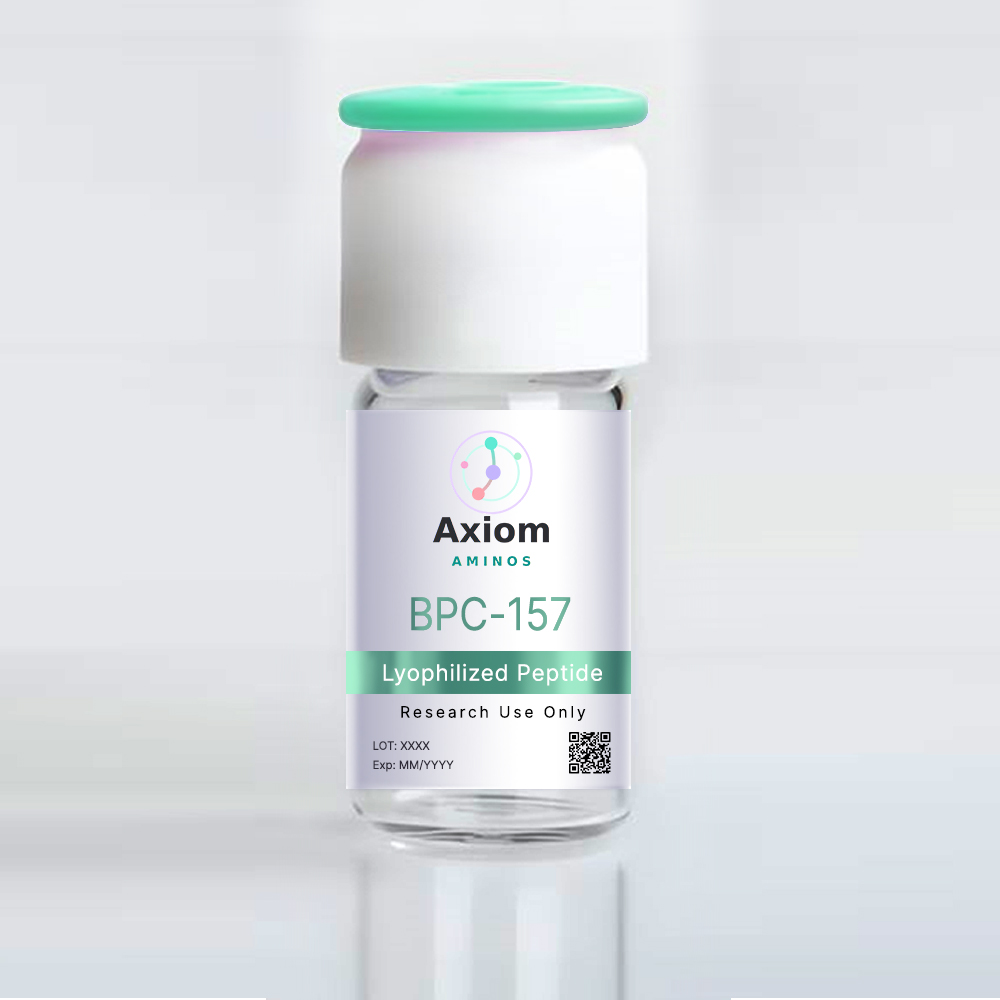
PEPTIDES
$99.00
⚠️ For Research Use Only — This product is not intended for human consumption. By purchasing, you confirm you are a qualified researcher.
BPC-157 (Body Protection Compound-157) is a synthetic 15-amino acid peptide derived from a protective protein found in human gastric juice. As a research-grade gastric pentadecapeptide, BPC-157 is studied in preclinical models for its effects on tissue repair mechanisms, angiogenesis, nitric oxide signaling, and cytoprotective pathways across multiple tissue types including gastrointestinal, musculoskeletal, and vascular models.
BPC-157 is a stable pentadecapeptide fragment of the larger Body Protection Compound protein identified in human gastric secretions. The peptide (Gly-Glu-Pro-Pro-Pro-Gly-Lys-Pro-Ala-Asp-Asp-Ala-Gly-Leu-Val) has demonstrated remarkable stability in gastric and intestinal conditions, resisting hydrolysis that rapidly degrades most peptides. Research has established BPC-157’s effects on multiple tissue repair pathways through a mechanism that appears to involve upregulation of growth factor expression, modulation of the nitric oxide (NO) system, and promotion of angiogenesis through VEGF receptor signaling. Published studies have demonstrated BPC-157’s effects in models of tendon, ligament, muscle, bone, and gastrointestinal tissue repair (Sikiric et al., Current Pharmaceutical Design, 2018). The peptide has also been shown to modulate FAK-paxillin pathway signaling, which plays a central role in cell migration, adhesion, and tissue remodeling. BPC-157 represents one of the most extensively studied cytoprotective peptides in preclinical research.
BPC-157 operates through multiple interconnected pathways. The peptide upregulates VEGFR2 expression and activates downstream angiogenic signaling including PI3K/Akt and MAPK/ERK cascades, promoting new blood vessel formation in injured tissues. BPC-157 modulates the NO system by influencing both endothelial NO synthase (eNOS) and inducible NO synthase (iNOS) activity, contributing to vasodilation and anti-inflammatory effects. The FAK-paxillin pathway is activated, promoting focal adhesion formation, cell migration, and extracellular matrix remodeling. Additionally, research has demonstrated BPC-157’s effects on growth factor expression including EGF, FGF, and TGF-β in repair models.
BPC-157 acts primarily through VEGFR2/angiogenesis and NO system modulation, while TB-4 (Thymosin Beta-4) promotes tissue repair through actin sequestration and cell migration. KPV acts as an anti-inflammatory tripeptide through melanocortin signaling. GHK-Cu modulates repair through copper-dependent matrix remodeling. These peptides offer complementary approaches to studying tissue repair mechanisms.
Related products in the Axiom Research Supply catalog: TB-4, KPV, GHK-Cu.
Reconstitute in bacteriostatic water or sterile saline. Store reconstituted peptide at 2–8°C. Lyophilized storage at -20°C. BPC-157 is stable across a wide pH range.
Axiom Research Supply provides BPC-157 at ≥98% (HPLC verified), verified through independent HPLC analysis with third-party testing documentation. Every batch undergoes rigorous quality control including identity confirmation, purity assessment, and endotoxin testing. Our peptides are properly lyophilized and shipped with cold-chain protocols to maintain stability from production to your laboratory. Axiom Research Supply is committed to advancing metabolic peptide science with precision, reproducibility, and dedicated research support. Access our educational resources including the Axiom Research Supply Metabolic Peptide Research eBook for comprehensive scientific background.
| Product Name | BPC-157 |
| Available Sizes | Multiple dosage options available — see product listing |
| CAS Number | 137525-51-0 |
| Molecular Formula | C62H98N16O22 |
| Molecular Weight | 1419.53 g/mol |
| Purity | ≥98% (HPLC verified) |
| Physical Form | Lyophilized Powder |
| Storage | Store at -20°C, protect from light and moisture |
| Peptide Class | Body Protection Compound (Gastric Pentadecapeptide) |
| Key Receptor Targets | Multiple targets including VEGFR2, NO system, FAK pathway |
| Research Applications | Tissue repair models, angiogenesis studies, nitric oxide signaling, gastrointestinal cytoprotection, tendon healing models |
Reviews
There are no reviews yet.