
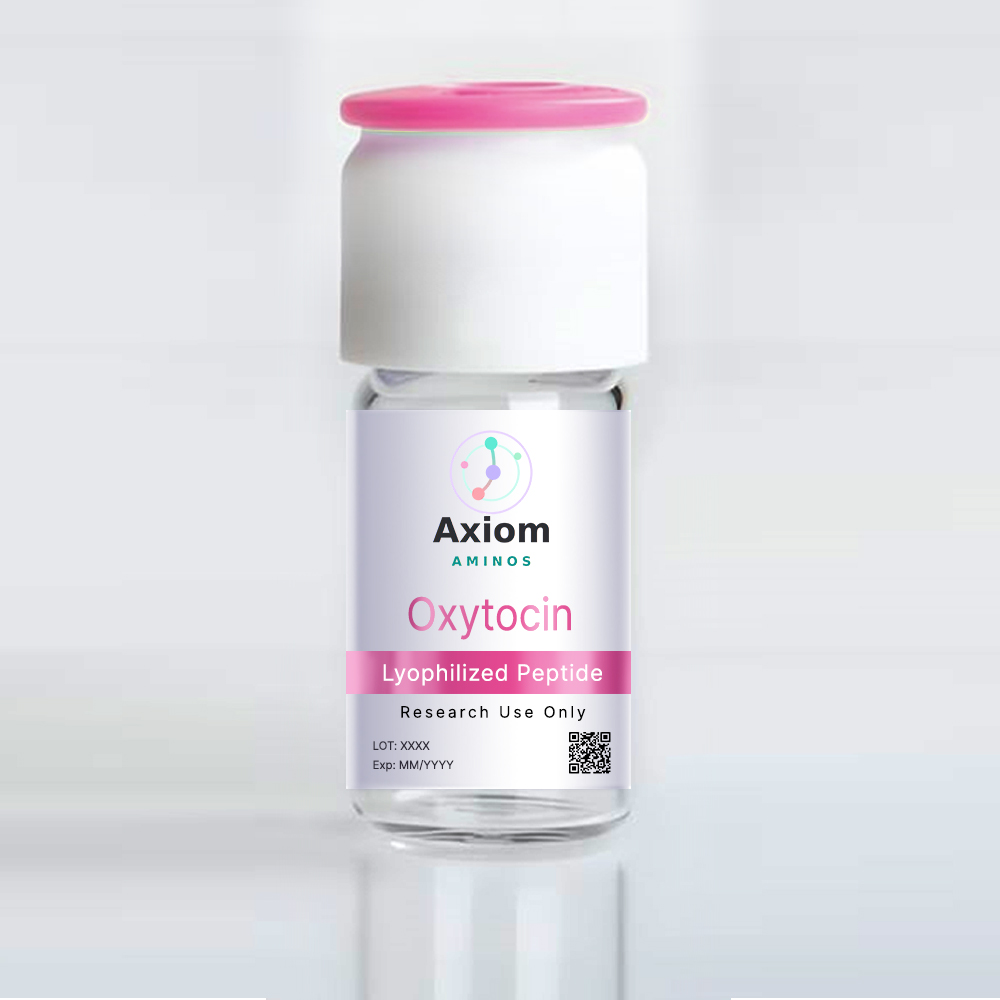
PEPTIDES
Oxytocin is a cyclic nonapeptide hormone produced in the hypothalamic paraventricular and supraoptic nuclei and released from the posterior pituitary. This research peptide activates the oxytocin rece…
$30.00
⚠️ For Research Use Only — This product is not intended for human consumption. By purchasing, you confirm you are a qualified researcher.
Oxytocin is a cyclic nonapeptide hormone produced in the hypothalamic paraventricular and supraoptic nuclei and released from the posterior pituitary. This research peptide activates the oxytocin receptor (OXTR), a Gq-coupled GPCR, and is studied in preclinical models of social behavior neurobiology, neuroendocrine regulation, and reproductive physiology.
Oxytocin (Cys-Tyr-Ile-Gln-Asn-Cys-Pro-Leu-Gly-NH2) was the first polypeptide hormone to be chemically synthesized, accomplished by Vincent du Vigneaud in 1953. The peptide forms a six-amino acid disulfide ring connected to a three-residue tail. Oxytocin acts through the OXTR, which couples to Gq/11 to activate PLC, IP3, and intracellular calcium signaling. In the CNS, oxytocin modulates social behavior, pair bonding, trust, and anxiety-like behaviors through effects on amygdala, hippocampus, and prefrontal cortex circuits. Peripherally, oxytocin stimulates uterine smooth muscle contraction and mammary gland myoepithelial cell activity. Published research has established oxytocin’s role in social cognition through modulation of GABAergic interneurons in the hippocampus and suppression of amygdala fear responses (Donaldson & Young, Science, 2008). The peptide’s dual central-peripheral actions make it essential for studying neuroendocrine integration.
Oxytocin binds the OXTR, activating Gq/11-mediated PLC/IP3/calcium signaling. In neurons, calcium mobilization modulates neurotransmitter release and synaptic plasticity. Oxytocin enhances GABAergic inhibition in the hippocampus, modulates amygdala reactivity, and influences dopaminergic signaling in reward circuits. In peripheral tissues, calcium-dependent smooth muscle contraction occurs through myosin light chain kinase activation. Oxytocin also demonstrates autocrine and paracrine signaling within the hypothalamus, amplifying its own release through positive feedback mechanisms.
Oxytocin acts through its own receptor system (OXTR) for social and reproductive signaling, distinct from PT-141’s melanocortin receptor mechanism. MT-1 and MT-2 target melanocortin receptors for pigmentation and broad melanocortin effects, respectively.
Related products in the Axiom Research Supply catalog: PT-141, MT-1, MT-2.
Reconstitute in sterile water. Store reconstituted peptide at 2–8°C and use promptly. Lyophilized storage at -20°C. Oxytocin is sensitive to oxidation and should be handled with care.
Axiom Research Supply provides Oxytocin at ≥98% (HPLC verified), verified through independent HPLC analysis with third-party testing documentation. Every batch undergoes rigorous quality control including identity confirmation, purity assessment, and endotoxin testing. Our peptides are properly lyophilized and shipped with cold-chain protocols to maintain stability from production to your laboratory. Axiom Research Supply is committed to advancing metabolic peptide science with precision, reproducibility, and dedicated research support. Access our educational resources including the Axiom Research Supply Metabolic Peptide Research eBook for comprehensive scientific
| Product Name | Oxytocin |
| Available Sizes | Multiple dosage options available — see product listing |
| CAS Number | 50-56-6 |
| Molecular Formula | C43H66N12O12S2 |
| Molecular Weight | 1007.19 g/mol |
| Purity | ≥98% (HPLC verified) |
| Physical Form | Lyophilized Powder |
| Storage | Store at -20°C, protect from light and moisture |
| Peptide Class | Neurohypophyseal Peptide Hormone |
| Key Receptor Targets | Oxytocin Receptor (OXTR) |
| Research Applications | Oxytocin receptor signaling, social behavior neurobiology, neuroendocrine regulation, uterine smooth muscle models, prosocial behavior research |
Reviews
There are no reviews yet.