
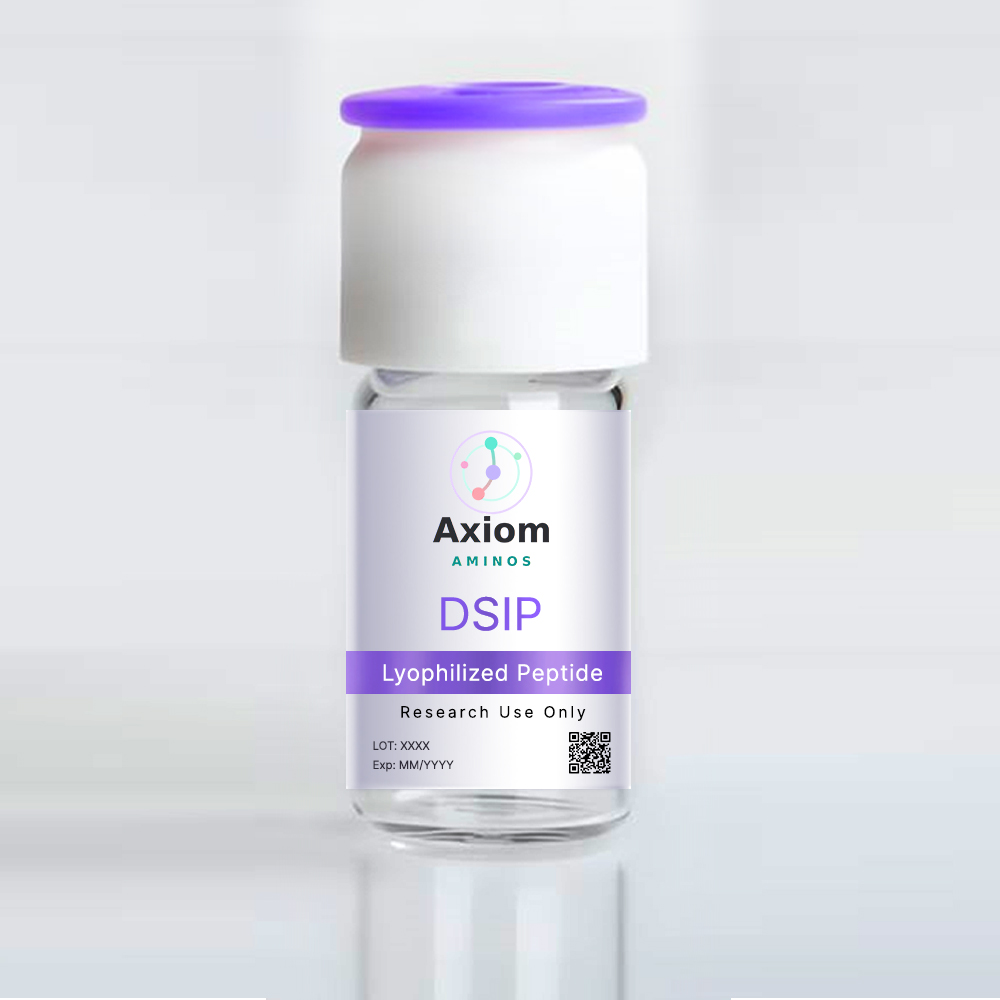
PEPTIDES
$89.00
⚠️ For Research Use Only — This product is not intended for human consumption. By purchasing, you confirm you are a qualified researcher.
Delta Sleep-Inducing Peptide (DSIP) is a naturally occurring nonapeptide first isolated from rabbit cerebral venous blood during electrically induced sleep. This research peptide is studied for its role in sleep architecture modulation, neuroendocrine regulation, and stress response pathways. DSIP is used in preclinical models examining the intersection of sleep physiology and hormonal signaling.
DSIP (Trp-Ala-Gly-Gly-Asp-Ala-Ser-Gly-Glu) was first identified in 1977 by Schoenenberger and Monnier during studies of transmissible sleep factors. The nonapeptide is found in both free and bound forms in the hypothalamus, limbic system, and peripheral tissues. Unlike classical neurotransmitter receptor agonists, DSIP appears to modulate multiple neuroendocrine systems rather than acting through a single identified receptor. Research has demonstrated that DSIP influences slow-wave sleep (delta sleep) patterns, ACTH and cortisol regulation, and LH signaling in preclinical models (Graf & Kastin, Peptides, 1986). The peptide’s mechanism of action remains an active area of investigation, with evidence suggesting involvement in serotonergic, GABAergic, and glutamatergic modulation. DSIP represents a unique research tool for studying the complex neuroendocrine regulation of sleep-wake cycles and stress physiology.
DSIP’s mechanism of action is multifaceted and not fully characterized. Research suggests the peptide modulates multiple neurotransmitter systems rather than acting through a single receptor. Evidence indicates DSIP may enhance GABAergic inhibitory tone, modulate serotonin receptor activity, and influence glutamatergic signaling in sleep-regulating brain regions. The peptide has also been shown to affect hypothalamic-pituitary-adrenal (HPA) axis activity, modulating ACTH and cortisol release under stress conditions. Its effects on delta sleep are believed to involve modulation of thalamocortical oscillatory circuits that generate slow-wave sleep patterns.
Unlike Selank and Semax, which act through defined receptor pathways (melanocortin and neurotrophic signaling, respectively), DSIP appears to modulate multiple neuroendocrine systems. Epithalon targets telomerase activation and pineal function, representing a distinct area of neuroendocrine research. DSIP is uniquely positioned for studying the complex neuropharmacology of sleep regulation.
Related products in the Axiom Research Supply catalog: Selank, Semax, Epithalon.
Reconstitute in sterile water. Store reconstituted peptide at 2–8°C and use within 14 days. Lyophilized storage at -20°C. DSIP is sensitive to oxidation; minimize exposure to air.
Axiom Research Supply provides DSIP at ≥98% (HPLC verified), verified through independent HPLC analysis with third-party testing documentation. Every batch undergoes rigorous quality control including identity confirmation, purity assessment, and endotoxin testing. Our peptides are properly lyophilized and shipped with cold-chain protocols to maintain stability from production to your laboratory. Axiom Research Supply is committed to advancing metabolic peptide science with precision, reproducibility, and dedicated research support. Access our educational resources including the Axiom Research Supply Metabolic Peptide Research eBook for comprehensive scientific background.
| Product Name | DSIP |
| Available Sizes | Multiple dosage options available — see product listing |
| CAS Number | 62568-57-4 |
| Molecular Formula | C35H48N10O15 |
| Molecular Weight | 848.81 g/mol |
| Purity | ≥98% (HPLC verified) |
| Physical Form | Lyophilized Powder |
| Storage | Store at -20°C, protect from light and moisture |
| Peptide Class | Neuropeptide (Delta Sleep-Inducing Peptide) |
| Key Receptor Targets | Multiple neuroendocrine targets (mechanism under investigation) |
| Research Applications | Sleep architecture research, neuroendocrine modulation studies, stress response models, circadian rhythm studies |
Reviews
There are no reviews yet.