
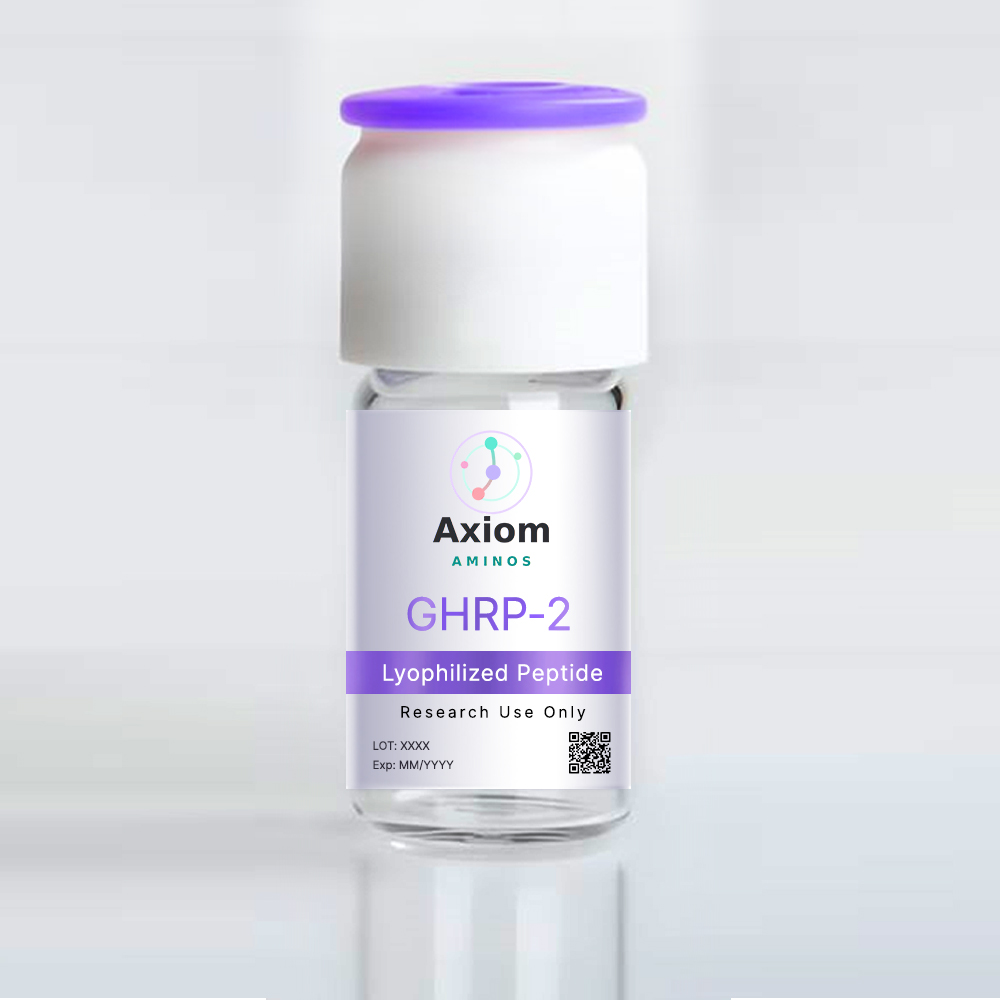
PEPTIDES
$99.00
⚠️ For Research Use Only — This product is not intended for human consumption. By purchasing, you confirm you are a qualified researcher.
GHRP-2 (Growth Hormone-Releasing Peptide 2) is a synthetic hexapeptide that acts as a potent agonist at the GHS-R1a receptor, stimulating growth hormone release from anterior pituitary somatotroph cells. As a research-grade ghrelin-mimetic peptide, GHRP-2 is widely used in preclinical studies investigating GH axis regulation, neuroendocrine signaling, and the pharmacology of growth hormone secretagogue receptors.
GHRP-2 (D-Ala-D-βNal-Ala-Trp-D-Phe-Lys-NH2) was among the earliest synthetic GH secretagogues developed through combinatorial peptide chemistry. It activates the GHS-R1a receptor with high potency, triggering Gq/11-mediated intracellular calcium signaling in pituitary somatotroph cells. Unlike the highly selective ipamorelin, GHRP-2 produces moderate stimulation of ACTH and cortisol alongside robust GH release, reflecting its broader receptor engagement profile. The peptide has been extensively characterized in published literature as a reference compound for studying GHS-R1a pharmacology. Research has demonstrated that GHRP-2 enhances GH release through both direct pituitary action and hypothalamic mechanisms, including stimulation of GHRH neurons and suppression of somatostatin tone (Bowers et al., Endocrine, 2004). GHRP-2 remains a standard tool in neuroendocrine research for evaluating pituitary GH reserve and studying the integrated hypothalamic-pituitary regulation of GH secretion.
GHRP-2 binds GHS-R1a on pituitary somatotrophs, activating Gq/11 and triggering PLC/IP3/calcium signaling cascades. Intracellular calcium mobilization drives GH vesicle exocytosis. Additionally, GHRP-2 acts at the hypothalamic level, stimulating GHRH-releasing neurons in the arcuate nucleus and reducing somatostatin inhibitory tone. This dual site of action—direct pituitary and indirect hypothalamic—produces a robust and synergistic GH response. The moderate cortisol elevation observed reflects GHRP-2’s partial engagement with CRH-related pathways at higher concentrations.
GHRP-2 is more potent than GHRP-6 in stimulating GH release per unit dose, with moderately less cortisol and prolactin elevation. Ipamorelin is more selective than GHRP-2, stimulating GH without cortisol effects. Researchers select GHRP-2 when they need robust GH stimulation and are studying the broader neuroendocrine response profile.
Related products in the Axiom Research Supply catalog: GHRP-6, Ipamorelin, Sermorelin.
Reconstitute in bacteriostatic water. Store reconstituted peptide at 2–8°C. Lyophilized storage at -20°C. Avoid repeated freeze-thaw cycles.
Axiom Research Supply provides GHRP-2 at ≥98% (HPLC verified), verified through independent HPLC analysis with third-party testing documentation. Every batch undergoes rigorous quality control including identity confirmation, purity assessment, and endotoxin testing. Our peptides are properly lyophilized and shipped with cold-chain protocols to maintain stability from production to your laboratory. Axiom Research Supply is committed to advancing metabolic peptide science with precision, reproducibility, and dedicated research support. Access our educational resources including the Axiom Research Supply Metabolic Peptide Research eBook for comprehensive scientific background.
| Product Name | GHRP-2 |
| Available Sizes | Multiple dosage options available — see product listing |
| CAS Number | 158861-67-7 |
| Molecular Formula | C45H55N9O6 |
| Molecular Weight | 817.97 g/mol |
| Purity | ≥98% (HPLC verified) |
| Physical Form | Lyophilized Powder |
| Storage | Store at -20°C, protect from light and moisture |
| Peptide Class | Growth Hormone-Releasing Peptide (Ghrelin Mimetic) |
| Key Receptor Targets | Growth Hormone Secretagogue Receptor 1a (GHS-R1a) |
| Research Applications | GHS-R1a receptor signaling, GH release studies, neuroendocrine axis research, pituitary cell models |
Reviews
There are no reviews yet.