
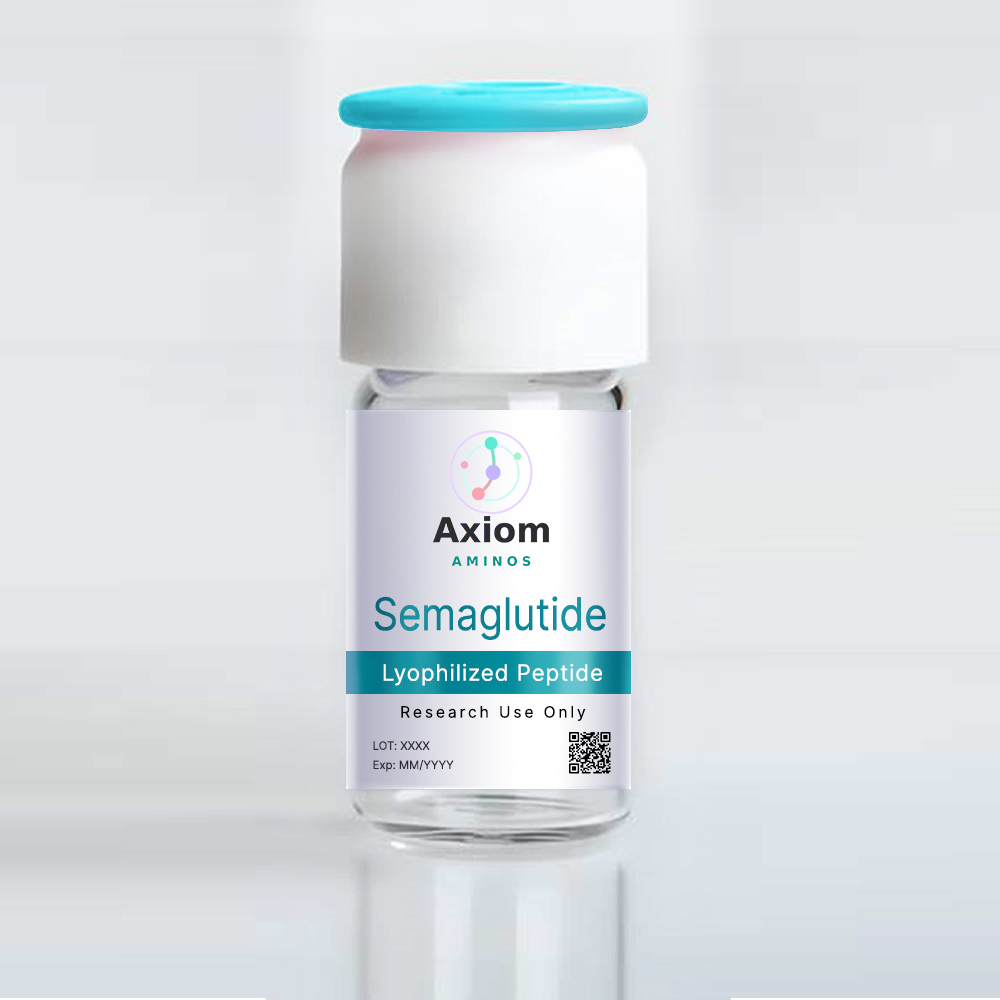
PEPTIDES
$139.00
⚠️ For Research Use Only — This product is not intended for human consumption. By purchasing, you confirm you are a qualified researcher.
Semaglutide is a long-acting GLP-1 receptor agonist research peptide engineered with an albumin-binding fatty acid side chain that extends its functional half-life. This 31-amino acid peptide activates the GLP-1R to stimulate glucose-dependent insulin secretion, suppress glucagon signaling, and modulate appetite-regulating pathways. Semaglutide is widely used in preclinical models investigating incretin biology, metabolic signaling, and energy homeostasis.
Semaglutide was developed through structural optimization of the GLP-1 peptide sequence to achieve extended receptor engagement and DPP-IV resistance. Key modifications include an Aib substitution at position 8 (preventing DPP-IV cleavage), a Lys34 modification with an octadecadioic acid fatty acid spacer (enabling non-covalent albumin binding), and an Arg34Lys substitution. These modifications extend the peptide’s functional half-life while maintaining high-affinity GLP-1R binding. Semaglutide activates the GLP-1R, a Gs-coupled GPCR expressed on pancreatic beta-cells, hypothalamic neurons, and gastrointestinal cells. Receptor activation triggers cAMP/PKA-mediated signaling that enhances glucose-dependent insulin secretion and suppresses glucagon release. In the CNS, GLP-1R activation on POMC and NTS neurons modulates satiety signaling. Published research has established semaglutide as a reference compound in incretin pharmacology (Liu, Frontiers in Endocrinology, 2024).
Semaglutide binds GLP-1R with high affinity, activating Gs-alpha and stimulating adenylyl cyclase. Elevated cAMP activates both PKA and Epac2 in pancreatic beta-cells, enhancing glucose-dependent insulin granule exocytosis. PKA-mediated CREB phosphorylation promotes beta-cell survival gene transcription. In alpha-cells, GLP-1R activation suppresses glucagon secretion through paracrine insulin and somatostatin signaling. Centrally, semaglutide activates GLP-1R on hypothalamic POMC neurons and brainstem NTS neurons, enhancing melanocortin-mediated satiety signaling. The albumin-binding fatty acid chain provides sustained receptor exposure through slow dissociation from albumin in circulation.
As a GLP-1R mono-agonist, semaglutide activates only one incretin receptor. Tirzepatide adds GIPR activation for enhanced metabolic effects, while retatrutide adds both GIPR and glucagon receptor activation. Cagrilintide acts through the amylin receptor rather than incretin receptors, offering a complementary mechanism.
Related products in the Axiom Research Supply catalog: Tirzepatide, Cagrilintide, Retatrutide.
Reconstitute in sterile water. Store reconstituted peptide at 2–8°C. Lyophilized storage at -20°C. Protect from light and moisture.
Axiom Research Supply provides Semaglutide at ≥98% (HPLC verified), verified through independent HPLC analysis with third-party testing documentation. Every batch undergoes rigorous quality control including identity confirmation, purity assessment, and endotoxin testing. Our peptides are properly lyophilized and shipped with cold-chain protocols to maintain stability from production to your laboratory. Axiom Research Supply is committed to advancing metabolic peptide science with precision, reproducibility, and dedicated research support. Access our educational resources including the Axiom Research Supply Metabolic Peptide Research eBook for comprehensive scientific background.
| Product Name | Semaglutide |
| Available Sizes | Multiple dosage options available — see product listing |
| CAS Number | 910463-68-2 |
| Molecular Formula | C187H291N45O59 |
| Molecular Weight | 4113.58 g/mol |
| Purity | ≥98% (HPLC verified) |
| Physical Form | Lyophilized Powder |
| Storage | Store at -20°C, protect from light and moisture |
| Peptide Class | GLP-1 Receptor Agonist |
| Key Receptor Targets | GLP-1 Receptor (GLP-1R) |
| Research Applications | GLP-1 receptor signaling, glucose-stimulated insulin secretion, appetite regulation, POMC neuron activation, hepatic lipid metabolism |
Reviews
There are no reviews yet.