
PEPTIDES
$129.00
⚠️ For Research Use Only — This product is not intended for human consumption. By purchasing, you confirm you are a qualified researcher.
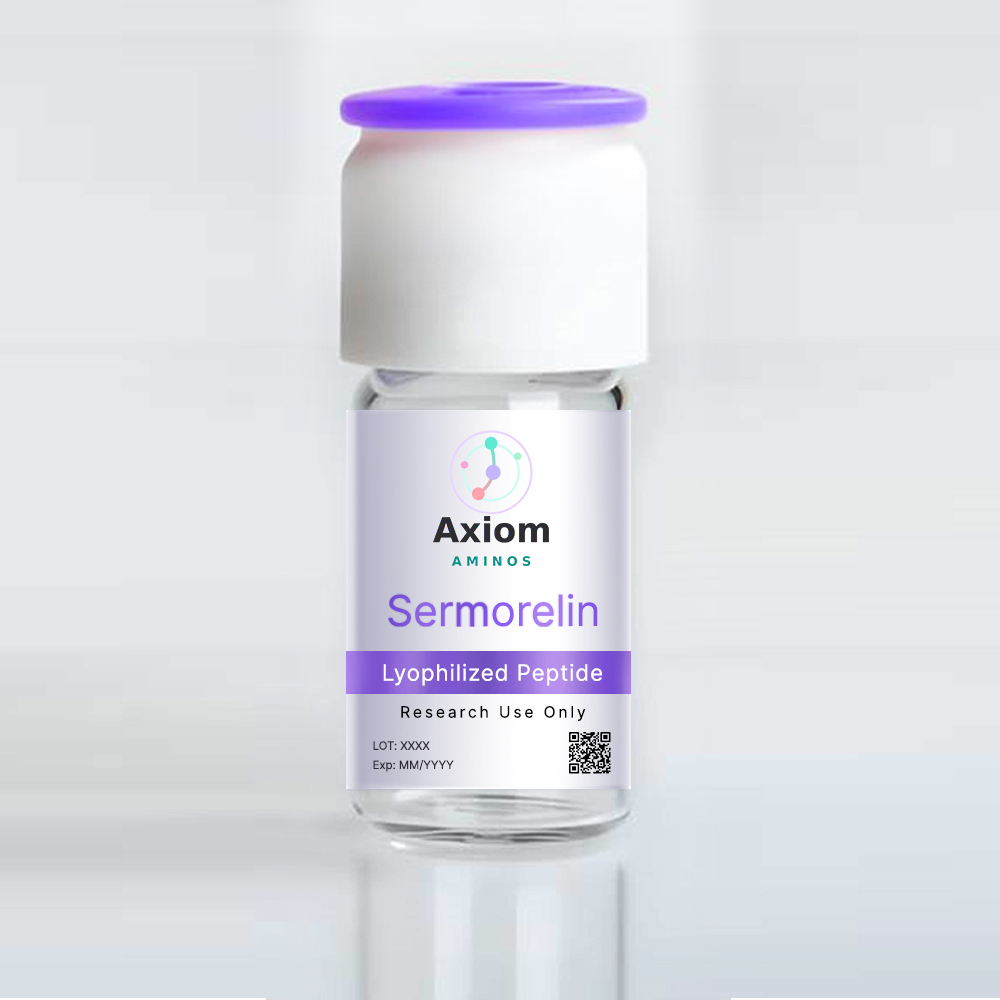
Sermorelin is a synthetic 29-amino acid peptide corresponding to the first 29 residues of naturally occurring growth hormone-releasing hormone (GHRH). As a GHRH analog research peptide, it binds to the GHRH receptor on anterior pituitary somatotroph cells, stimulating the pulsatile release of growth hormone through cAMP-mediated signaling. Sermorelin is widely studied in preclinical models examining GH axis regulation, age-related somatopause, and pituitary function.
Sermorelin (GRF 1-29 NH2) was originally developed in the 1980s as a truncated analog of endogenous GHRH(1-44). Research demonstrated that the first 29 amino acids retain full biological activity at the GHRH receptor, making sermorelin an efficient tool for studying somatotroph cell physiology. The peptide activates the GHRH receptor, a G-protein coupled receptor (GPCR) on anterior pituitary cells, triggering adenylyl cyclase activation and cAMP accumulation. This cascade activates protein kinase A (PKA), which phosphorylates transcription factors including CREB, ultimately stimulating GH gene transcription and secretion. Published research has demonstrated that sermorelin preserves the physiological pulsatile pattern of GH release, distinguishing it from direct GH administration in experimental models (Prakash & Bhatt, Peptides, 2020). Investigators use sermorelin to study feedback mechanisms within the hypothalamic-pituitary-somatotroph axis, the role of GH in metabolic regulation, and age-dependent changes in GHRH receptor sensitivity. As a research peptide, sermorelin provides a controlled and reproducible tool for examining the upstream regulation of the GH-IGF-1 axis.
At the molecular level, sermorelin binds to the extracellular domain of the GHRH receptor on pituitary somatotroph cells. This binding activates the Gs-alpha subunit of the associated G-protein, stimulating adenylyl cyclase and increasing intracellular cAMP concentrations. Elevated cAMP activates PKA, which phosphorylates CREB (cAMP response element-binding protein) at Ser133, driving transcription of the GH1 gene. Additionally, cAMP-mediated signaling opens voltage-gated calcium channels, facilitating calcium influx that triggers GH vesicle exocytosis. Research has shown that sermorelin-induced GH release is modulated by somatostatin (SST), which acts as a counter-regulatory signal through SST receptor subtypes on the same cells. This reciprocal regulation makes sermorelin an essential tool for studying the integrated control of GH secretion in vitro and in vivo laboratory models.
Compared to CJC-1295 (No DAC), which is a modified GHRH analog with enhanced DPP-IV resistance and extended half-life, sermorelin provides a shorter-acting stimulus better suited for studying acute GH pulse dynamics. Ipamorelin, by contrast, acts through the GHS-R1a (ghrelin receptor) rather than the GHRH receptor, offering a complementary mechanism for studying GH release from a different signaling axis. Researchers often combine sermorelin with ghrelin-mimetic peptides to study synergistic GH release patterns.
Related products in the Axiom Research Supply catalog: CJC-1295, Ipamorelin, GHRP-2.
Reconstitute sermorelin in bacteriostatic water or sterile 0.9% sodium chloride at a concentration appropriate for the experimental protocol. Store reconstituted solutions at 2–8°C and use within 30 days. Lyophilized peptide should be stored at -20°C. Follow ARRIVE 2.0 guidelines for reproducible in vivo experimental designs.
Axiom Research Supply provides Sermorelin at ≥98% (HPLC verified), verified through independent HPLC analysis with third-party testing documentation. Every batch undergoes rigorous quality control including identity confirmation, purity assessment, and endotoxin testing. Our peptides are properly lyophilized and shipped with cold-chain protocols to maintain stability from production to your laboratory. Axiom Research Supply is committed to advancing metabolic peptide science with precision, reproducibility, and dedicated research support. Access our educational resources including the Axiom Research Supply Metabolic Peptide Research eBook for comprehensive scientific background.
| Product Name | Sermorelin |
| Available Sizes | Multiple dosage options available — see product listing |
| CAS Number | 86168-78-7 |
| Molecular Formula | C149H246N44O42S |
| Molecular Weight | 3357.88 g/mol |
| Purity | ≥98% (HPLC verified) |
| Physical Form | Lyophilized Powder |
| Storage | Store at -20°C, protect from light and moisture |
| Peptide Class | Growth Hormone-Releasing Hormone (GHRH) Analog |
| Key Receptor Targets | GHRH Receptor (GHRH-R) |
| Research Applications | GH axis signaling, pituitary function studies, somatotroph cell research, age-related GH decline models |
Reviews
There are no reviews yet.